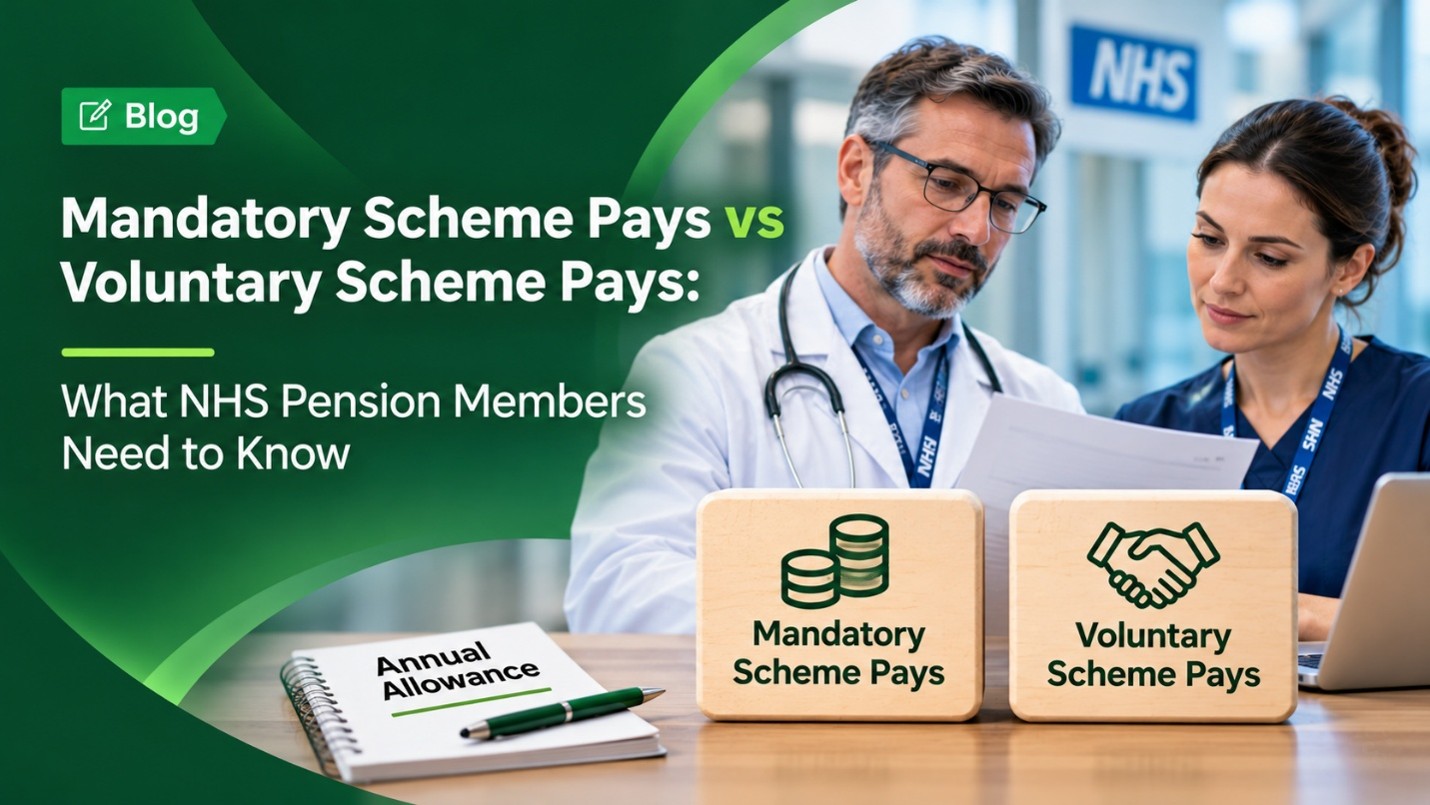
If you have exceeded your Annual Allowance in the NHS Pension Scheme, you may face an Annual Allowance tax charge. However, you do not necessarily have to pay the entire charge directly from your personal savings.
The NHS Pension Scheme offers two facilities that may allow you to ask NHS Pensions to pay some or all of your Annual Allowance tax charge to HM Revenue & Customs (HMRC):
Mandatory Scheme Pays and Voluntary Scheme Pays
Although both options can reduce the need to pay the tax charge upfront, they have different eligibility conditions and responsibilities.
Understanding the difference is important, particularly for doctors, GPs and other NHS professionals with pension growth that exceeds their available Annual Allowance.
What Is Scheme Pays?
Scheme Pays is an arrangement that allows an eligible pension scheme member to ask their pension scheme to pay some or all of their Annual Allowance tax charge directly to HMRC.
In return, the member’s pension benefits are reduced to reflect the amount paid by the scheme.
The NHS Pension Scheme offers two types:
- Mandatory Scheme Pays
- Voluntary Scheme Pays
The option available depends on your pension growth, Annual Allowance position and the relevant scheme conditions.
1. What Is Mandatory Scheme Pays?
Mandatory Scheme Pays is available when specific HMRC eligibility conditions are met. If you qualify and submit a valid election within the deadline, the pension scheme is required to pay the eligible charge.
For NHS Pension Scheme members, the main conditions are:
- Your Pension Input Amount in either the 1995/2008 Scheme or the 2015 Scheme must exceed the standard Annual Allowance.
- Your Annual Allowance tax charge for that year must be more than £2,000.
- You must submit your election within the relevant deadline.
If accepted, NHS Pensions pays the eligible charge to HMRC. The Where a valid Mandatory Scheme Pays election is accepted, NHS Pensions becomes jointly and severally liable with you for the relevant Annual Allowance tax charge, although you still need to report the Annual Allowance charge through Self-Assessment.
2. What Is Voluntary Scheme Pays?
Voluntary Scheme Pays provides another option where you do not meet the conditions for Mandatory Scheme Pays.
Under this arrangement, the pension scheme may agree to pay some or all of your Annual Allowance tax charge, even when the mandatory conditions are not satisfied.
For NHS Pension Scheme members, this can be particularly relevant where:
- Your pension growth exceeds your tapered or alternative Annual Allowance but remains below the standard Annual Allowance.
- You are a member of both the 1995/2008 and 2015 NHS Pension Schemes, and your combined pension growth exceeds your available Annual Allowance.
- Your Annual Allowance tax charge is £2,000 or less.
Unlike Mandatory Scheme Pays, there is no minimum £2,000 tax charge requirement for NHS Voluntary Scheme Pays.
However, acceptance is subject to the NHS Pension Scheme’s conditions.
One important distinction concerns late payment. If NHS Pensions pays your charge through Voluntary Scheme Pays after the HMRC Self-Assessment payment deadline of 31 January, you remain responsible for any late payment interest charged by HMRC.
Mandatory vs Voluntary Scheme Pays: Key Differences
| Feature | Mandatory Scheme Pays | Voluntary Scheme Pays |
| Availability | Must be offered if HMRC conditions are met | Subject to scheme acceptance |
| Pension growth condition | Must exceed the standard Annual Allowance in one NHS scheme | Can apply where growth exceeds the tapered or alternative allowance, or combined NHS scheme growth exceeds the available allowance |
| Minimum tax charge | More than £2,000 | No minimum charge |
| Payment responsibility | Scheme is responsible for the eligible payment | Member remains responsible for late payment interest if payment is late |
| Pension impact | Reduction to NHS pension benefits | Reduction to NHS pension benefits |
| Election deadline | Generally 31 July in the following year | Generally 31 July in the following year |
Both arrangements can be used to pay an eligible Annual Allowance charge relating to NHS pension growth. They cannot be used to pay charges arising from pension savings outside the NHS Pension Scheme.
What Is the Deadline for Applying?
For NHS Pension Scheme members, the usual deadline for submitting a Scheme Pays election is 31 July in the year following the January in which the Annual Allowance charge must be declared on your Self Assessment tax return.
For example, if your Annual Allowance charge relates to the 2025/26 tax year:
- Tax year ends: 5 April 2026
- Self Assessment payment deadline: 31 January 2027
- Usual Scheme Pays election deadline: 31 July 2027
It is important to understand that the Scheme Pays election deadline and HMRC tax payment deadline are different.
If you are considering Voluntary Scheme Pays, submitting your election early is particularly important because late payment interest may remain your responsibility.
You should also avoid delaying your election solely because you have not received your Pension Savings Statement. NHS Pensions allows members to estimate their liability where necessary to meet the relevant deadline.
How Does Scheme Pays Affect Your NHS Pension?
One of the most important considerations is that Scheme Pays is not a payment without consequences.
When NHS Pensions pays an Annual Allowance charge on your behalf, the cost is recovered through a reduction to your pension benefits.
The reduction is permanent and its value depends on factors including your age and the interest applied when you retire.
This means that although Scheme Pays can reduce the need to use personal savings to pay a tax charge, it can affect the pension income you receive in retirement.
Before making an election, consider the long-term impact alongside the immediate tax liability.
How Do You Apply for Scheme Pays?
If you want NHS Pensions to pay some or all of your Annual Allowance tax charge, you need to complete the Scheme Pays Election Notice (SPE2).
If you are a member of both the 1995/2008 and 2015 NHS Pension Schemes and want both schemes to contribute towards the payment, you must complete the relevant sections for each scheme and specify how much each should pay.
You should also remember:
- You must use the latest version of the SPE2 form.
- The election must be received by the relevant deadline.
- Once accepted, you cannot simply cancel the election and pay the charge yourself instead.
- You must still report the Annual Allowance charge on your Self Assessment tax return, even if the scheme pays it.
You can find the relevant form and further information on the NHS Business Services Authority website.
How Wealth Genius Can Support NHS Professionals
Understanding the Annual Allowance and Scheme Pays arrangements can be complicated, particularly if you are a doctor or GP with membership across different NHS pension arrangements.
At Wealth Genius, we support NHS and medical professionals in understanding their pension position, Annual Allowance considerations and wider retirement planning.
If you have received a Pension Savings Statement or are concerned about a potential Annual Allowance tax charge, understanding your options can be an important part of reviewing your long-term financial plans.
Key Takeaway
Mandatory Scheme Pays and Voluntary Scheme Pays both provide ways for eligible NHS Pension Scheme members to manage an Annual Allowance tax charge without necessarily paying the entire amount from personal savings.
The main difference is that Mandatory Scheme Pays applies when specific HMRC eligibility conditions are met, whereas Voluntary Scheme Pays may be available in additional circumstances, subject to scheme acceptance.
However, both arrangements reduce your NHS pension benefits, so the long-term implications should be considered before making an election.
Tax treatment depends on individual circumstances and may be subject to change.
Important Information
This article is provided for educational and informational purposes only and does not constitute financial advice or a personal recommendation.
The reduction to NHS pension benefits resulting from a Scheme Pays election will depend on the applicable scheme factors and individual circumstances. Check the latest NHS Pensions guidance before making an election.
Frequently Asked Questions
Mandatory Scheme Pays must be offered when the relevant HMRC eligibility conditions are met. Voluntary Scheme Pays is subject to the pension scheme’s acceptance and can cover certain circumstances that do not qualify for mandatory payment.
No. NHS Pensions does not require the Annual Allowance tax charge to exceed £2,000 for Voluntary Scheme Pays.
You may request payment of up to 100% of the charge relating to your NHS pension benefits, using Mandatory Scheme Pays, Voluntary Scheme Pays or a combination of both, subject to acceptance and the applicable conditions.
Yes. You must report the charge through your Self-Assessment tax return, even if NHS Pensions pays some or all of it.
Yes. The cost of the tax charge paid by NHS Pensions is recovered through a reduction to your NHS pension benefits.
No. The NHS Scheme Pays facilities described here can only cover Annual Allowance charges arising from growth in your NHS Pension Scheme benefits. Charges relating to pension savings outside the NHS scheme cannot be paid through this facility.

Leave a Reply